
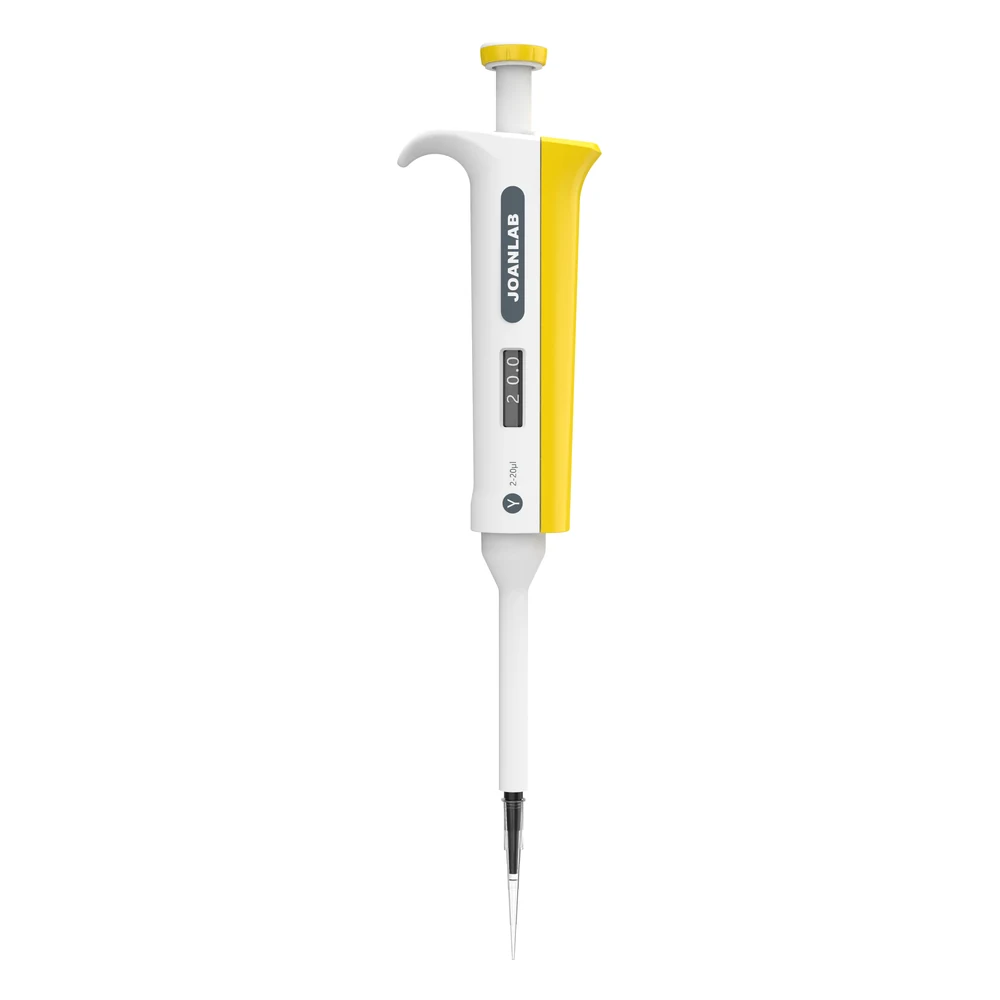
JOANLAB autoclavable single-channel micropipette · Y series
Fully autoclavable single-channel micropipettes in nine ranges from 0.1 µL to 10 mL, color-coded by tip size.
- Nine ranges, from 0.1 µL to 10 mL
- Fully autoclavable, according to the manufacturer
- Same ranges and increments as the M series, which is not autoclavable
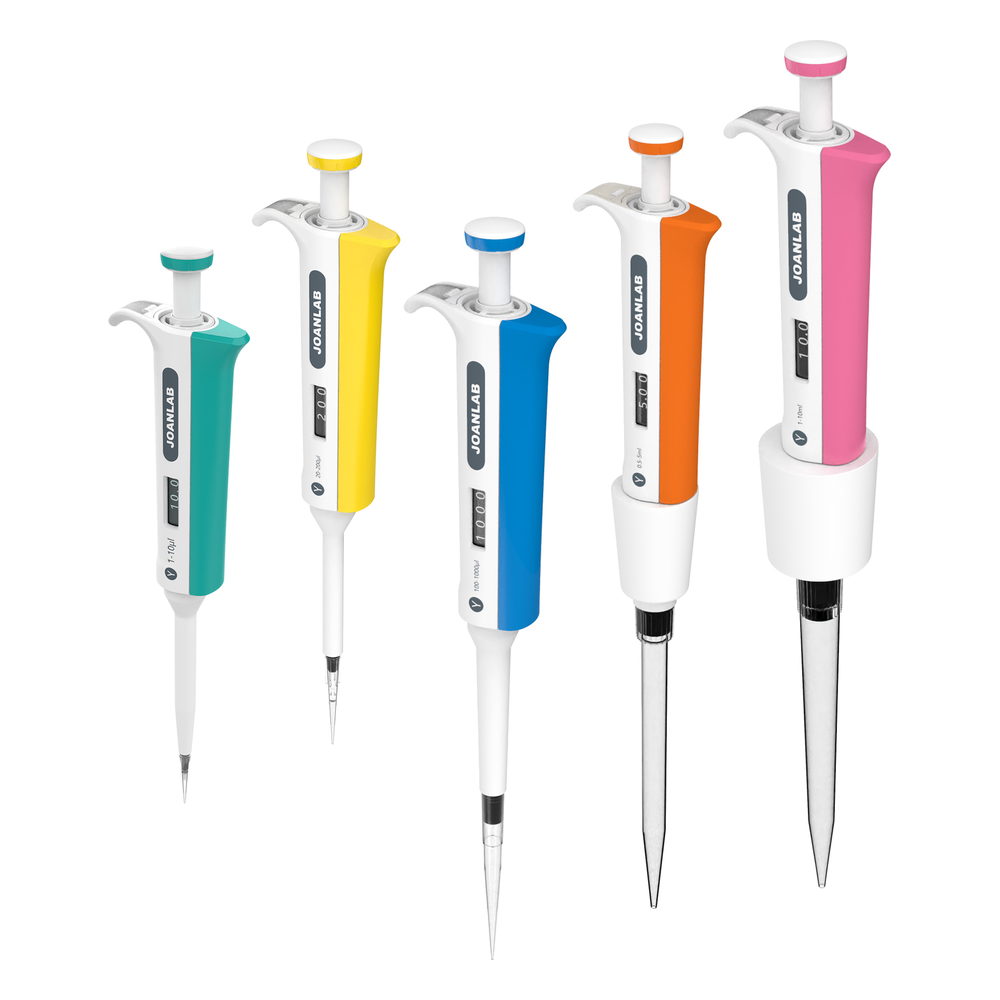
- Color code by tip size, in five groups
Manufacturer video
It starts with what is in the box —pipette, calibration tool, stand, tips and lubricant— and goes on to technique: setting the volume with the wheel, aspirating by pressing the plunger to the first stop and releasing it slowly, and dispensing by pressing it down to the second stop. This is the maneuver that separates a reproducible aliquot from one that is not.
Original material from JOANLAB, with no audio and with on-screen text in English.
Summary datasheet
| Models and ranges | Y2.5 (0.1-2.5 µL), Y10 (0.5-10 µL), Y20 (2-20 µL), Y50 (5-50 µL), Y100 (10-100 µL), Y200 (20-200 µL), Y1000 (100-1000 µL), Y5000 (0.5-5 mL) and Y10000 (1-10 mL) |
| Sterilization | Fully autoclavable at 121 °C, 1 atmosphere, 20 minutes, up to 10 cycles. The manufacturer indicates wrapping it in gauze before autoclaving and letting it air-dry for 12 h before using it again |
| Setting increment | 0.05 µL (Y2.5), 0.1 (Y10), 0.5 (Y20 and Y50), 1 (Y100 and Y200), 5 (Y1000), 50 (Y5000) and 100 µL (Y10000) |
| Stated systematic error | At the nominal volume, from ±2.5% on the Y2.5 to ±0.6% on the Y10000. The manufacturer also states it at half and at one tenth of the nominal volume, where it degrades: ±25% (Y2.5), ±12% (Y10), ±10% (Y20 and Y50), ±8% (Y100 to Y5000) and ±6% (Y10000) |
| Stated random error | At the nominal volume, from ±2.0% on the Y2.5 to ±0.3% from the Y100 up. At one tenth of the nominal volume: ±20% (Y2.5), ±8% (Y10), ±5% (Y20 and Y50) and ±3% (Y100 to Y10000) |
| Tolerance in microliters | The manufacturer also states the absolute error, and it is the same at the three test volumes of each model. Systematic: ±0.06 (Y2.5), ±0.12 (Y10), ±0.2 (Y20), ±0.5 (Y50), ±0.8 (Y100), ±1.6 (Y200), ±8 (Y1000), ±40 (Y5000) and ±60 µL (Y10000). Random, in the same order: ±0.05, ±0.08, ±0.1, ±0.25, ±0.3, ±0.6, ±3, ±15 and ±30 µL |
| Test volumes | The manufacturer states the tolerance at the nominal volume, at half of it and at one tenth of it, and not at the lower end of the range of the Y2.5 or of the Y10 |
| Relation to the other single-channel series | It shares ranges and increments with the M series and adds autoclaving and a color code. The X series offers a much finer setting and resistance to weak acids and alkalis, and is also fully autoclavable; the P series is too, at 121 °C, but its catalog states neither the cycle time nor the number of cycles. The same Y series exists in 8- and 12-channel formats |
| Compatible tips | 10 µL (Y2.5 and Y10), 200 µL (Y20, Y50, Y100 and Y200), 1000 µL (Y1000), 5000 µL (Y5000) and 10 mL (Y10000). The manufacturer states that it accepts tips from other brands |
| Color code | Five colors for the nine models, grouped in the same way as the tips: turquoise (Y2.5 and Y10), yellow (Y20, Y50, Y100 and Y200), blue (Y1000), orange (Y5000) and pink (Y10000) |
| What is in the box | Pipette, tips, calibration tool with hex key, identification card, stand, quick guide and calibration certificate |
| Availability | Import to order / to be confirmed |
The one publishing its full tolerance: three points, in µL and %
It is the only single-channel series whose catalog states systematic and random error in absolute value as well as percentage, at three volumes per model. That table lets neighboring steps be compared with numbers rather than intuition: between carrying 10 µL on the Y10 (±1.2%) or on the Y20 (±2%), the table decides by itself.
The nine ranges cover 0.1 µL to 10 mL, with color identification by size.
Fully autoclavable, and available today
It shares with the P and X series the whole-instrument autoclave statement, and adds the most explicit metrological table on the page. Against the X series, which adds resistance to weak acids and alkalis and finer increments, the Y is the only one that publishes its tolerance model by model at all three volumes, and in microliters as well as percentage.