
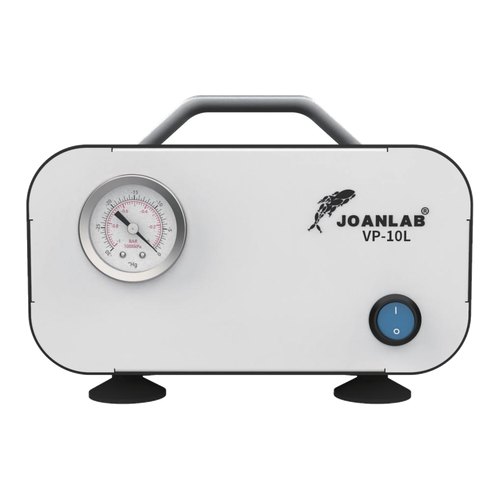
 Oil-free, with pressure gauge
Laboratory vacuum pumps from JOANLAB
2 families of laboratory vacuum pumps from JOANLAB: diaphragm pumps and pressure and vacuum pumps. Models, configuration and availability are confirmed in the quote.
2 product families
Oil-free, with pressure gauge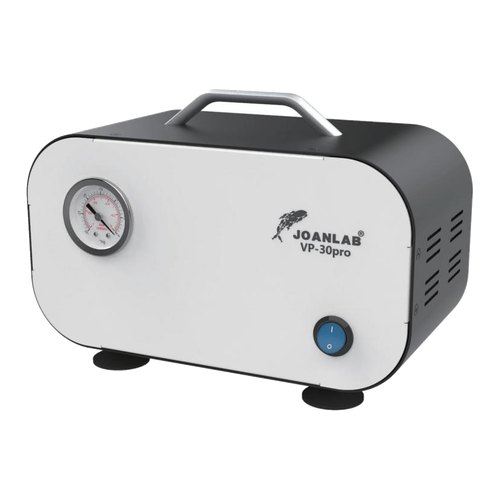 Adjustable pressure and speed
Pressure and vacuum pumps
JOANLAB pressure and vacuum pump · VP-Pro series
VP-20Pro · VP-30Pro · VP-40Pro · VP-55Pro
- Flow
- 20-55 L/min
- Max. vacuum
- 0.08-0.088 MPa
What a diaphragm pump does
A vacuum pump does not suck: it removes gas. The diaphragm pump does it with a flexible membrane inside a chamber with two check valves. On the way back it lets in the gas from the setup; on the way forward it expels it through the other path. Each stroke takes out a fraction of what is left: pressure falls quickly at first and more and more slowly afterwards.
Every pump on this page is an oil-free diaphragm pump: there is no lubricant in contact with the gas that could travel back as a mist toward the setup, and no oil to change.
The ceiling is somewhere else. The membrane does not sweep the whole volume of the chamber, and the gas in the dead space expands again on the following stroke. That is why this type of pump covers vacuum filtration, desiccators and solvent degassing well, and not the applications that work orders of magnitude further down, such as high vacuum.
Flow rate and maximum vacuum decide different things
The datasheets carry two numbers that are easy to confuse. The flow rate, in L/min, is how fast the pump removes the gas: it sets how long the setup takes to reach working pressure and how much leakage it can compensate for. The maximum vacuum, in MPa, is how far down it can go; once there, waiting longer does nothing.
On this page the flow rates run from 10 to 55 L/min and the maximum vacuums from 0.075 to 0.088 MPa: the first number varies far more than the second. Moving up a model buys speed much more than depth. When a process does not reach the pressure it needs, the cause is usually a leak in the setup, a vapor that keeps being generated, or the type of pump. More flow partly compensates for the first two, but they are fixed at the root in the setup and not in the pump; the third no flow rate corrects, because the maximum vacuum is the ceiling of the operating principle.
Drawing, pushing, measuring and regulating
The same head that draws can push: on the forward stroke the membrane compresses the gas. There are models that declare positive pressure as well and others that declare suction only; the Type row on each datasheet says so.
Measuring the vacuum and adjusting it are not the same thing either. A gauge tells you where you are; a regulating valve lets you choose. It is worth checking which one the unit you are looking at declares. The maximum vacuum is not always the best working point: in filtration, past a certain point, the filtrate starts to evaporate and fines are dragged through the filter.
What must not reach the head
A diaphragm pump moves gas. Liquid that gets in by accident reaches the chamber and ruins the membrane; vapor that condenses inside does the same, more slowly. A trap flask between the setup and the pump holds back droplets and condensate: the catalog does not declare one.
The membrane is an elastomer and not all of them resist the same things. The datasheets declare rubber, without specifying which one or declaring chemical compatibility. If what you are going to evacuate carries solvent or acid vapors, confirm it with the supplier before buying.
Worth having on hand before requesting a quote
What you are going to evacuate, what pressure the process needs to reach, in how long, and how many stations will work in parallel: that sets the flow rate.
The diameters of the tubing you already have: not all the datasheets declare the diameter of the port and of the hose, so it is worth measuring them.
The bench space, the voltage available —which is confirmed in the quote— and, if the unit ends up in an occupied room, the noise level, which not all of them declare either.
View the full catalog · View autoclaves · View refrigerators · View stirrers and shakers · View pipetting and dispensing · View balances · View heating equipment · View ultrasonic cleaning · View spectrophotometers · View infrared sterilizers
Cannot find the equipment you need?
Describe the equipment you are looking for and we will prepare a quote, whether or not it appears in our catalog.